
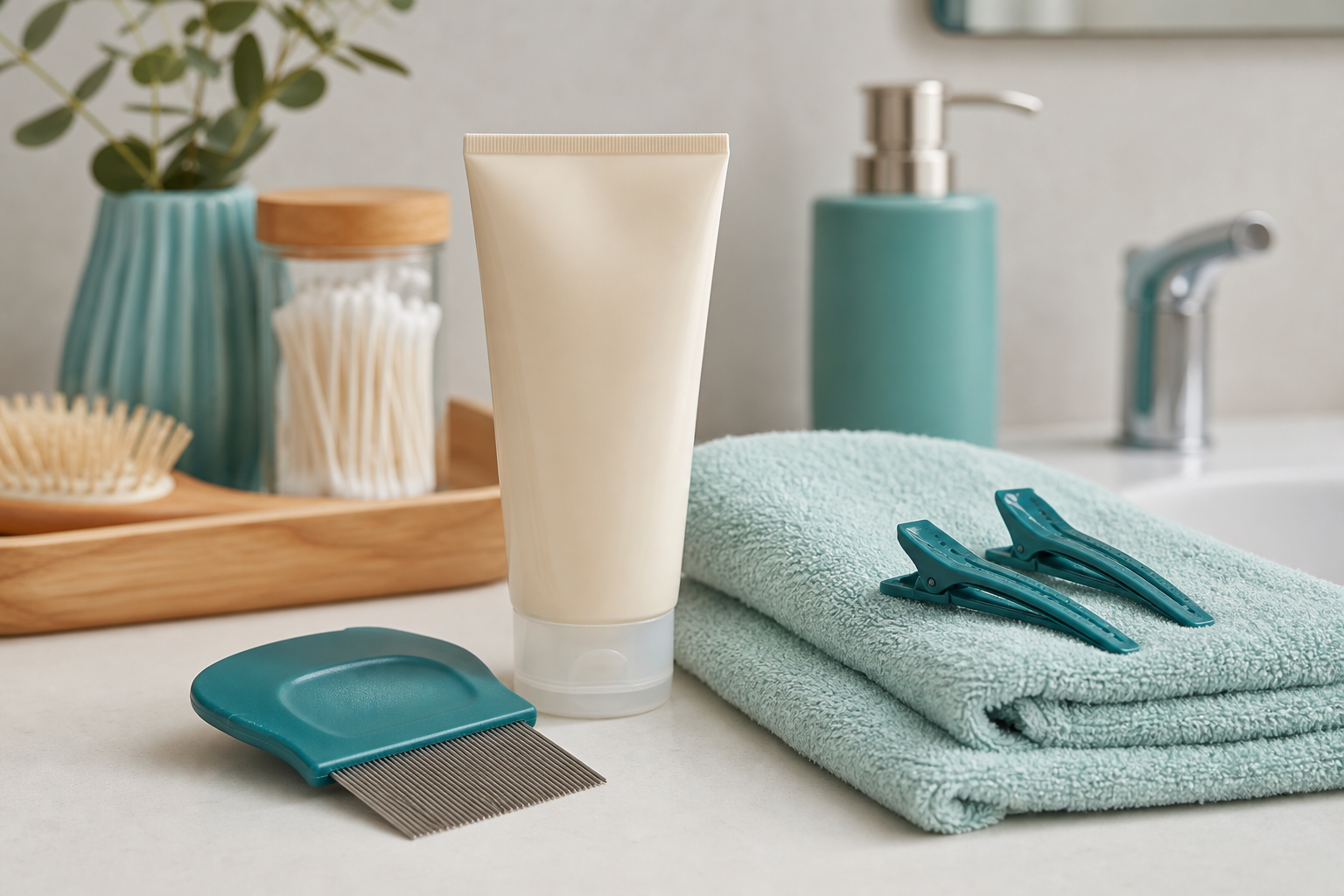
Head lice are small insects that live in human hair and feed from the scalp. They spread mainly through direct head-to-head contact; they do not jump or fly, and infestation is unrelated to cleanliness. Nits are eggs attached to hairs, while white empty shells may remain after a louse has hatched.
Itching can occur when someone reacts to louse saliva, but many people have no symptoms. The only reliable confirmation is finding a live louse with a fine-toothed detection comb. Dandruff or hair-product residue can resemble nits, but usually brushes away more easily.
Checking and treating everyone together
Check household members and other close contacts and treat everyone with live lice on the same day. Children do not need to stay away from school. There is no need for a hot laundry wash or extensive household spraying because lice survive poorly away from the scalp.
Wet combing is an effective non-medicinal option. Wash with ordinary shampoo, apply plenty of conditioner and comb methodically from roots to ends with a detection comb. Comb the entire head twice. Repeat on days 1, 5, 9 and 13, then check again on day 17 to catch lice that hatch after the first session.
If wet combing is unsuitable or unsuccessful, a pharmacist can recommend an appropriate medicated lotion or spray. Some products require a second application after seven days. Follow the label for age limits, pregnancy, allergies and application time; more product does not improve effectiveness.
What not to rely on
Routine use of insecticidal products to prevent lice can irritate the scalp and encourages unnecessary exposure. Plant oils and essential oils such as tea tree, eucalyptus and lavender are not recommended as dependable treatments. Essential oils can irritate skin and may be toxic if swallowed. Permethrin products, electric combs and commercial “repellents” are also unlikely to work reliably.
Head lice are inconvenient rather than a sign of poor parenting or hygiene. Calm, factual handling helps children avoid embarrassment. Persistent live lice after correctly completed treatment should be discussed with a pharmacist, who can check technique and recommend an alternative.
Useful topical options
Supplements should be selected for the individual rather than used automatically. Product directions and advice from an appropriately qualified professional should take precedence over general information.
| Supplement | Effects |
|---|---|
| Aloe vera juice | When applied topically, it is described as soothing itching and irritation associated with a scalp reaction to lice. |
| Coconut oil | When applied topically, it can condition a dry scalp and has traditionally been included in head-lice routines. |
These products are topical rather than nutritional and neither is a proven replacement for wet combing or a licensed head-lice treatment. Aloe and coconut products may cause contact reactions, so stop if irritation develops and avoid the eyes. Food-grade products are not automatically suitable for prolonged application to the scalp.
The practical essentials are to confirm live lice, treat affected close contacts at the same time, complete the full combing or product schedule and recheck. Repeated preventive chemical treatment and laborious house cleaning add burden without addressing the main route of spread.
Looking for personalised nutrition and lifestyle support? An FNTP member may be able to help you explore an approach suited to your individual needs. Find an FNTP practitioner.
This article is for general education and does not replace individual medical advice, diagnosis or treatment.